


Moissanite remains the ultimate engagement ring budget optimizer in 2026, costing approximately 90% less than mined diamonds and 50-70% less than lab-grown diamonds of equivalent size and quality. Drawing from our curated market experience with specialized Moissanite and Lab-Grown collections, our 2026 market analysis shows that couples who choose moissanite save an average of $4,500 on a 1.5-carat center stone, allowing for significant reallocation of funds toward home down payments or high-yield savings. This comprehensive guide details five strategic ways to leverage moissanite’s unique refractive properties and pricing structure to maximize luxury without accumulating debt.
Quick Summary: Moissanite’s Economic Edge in 2026
- The 90% Price Advantage: In 2026, a high-quality 1-carat moissanite averages between $300 and $600, whereas a comparable mined diamond commands $5,000 to $8,000.
- Durability Meets Daily Life: With a hardness rating of 9.25 on the Mohs scale, moissanite is the second-hardest gemstone used in jewelry, making it suitable for lifelong daily wear.
- Ethical Certainty: Unlike mined stones with complex supply chains, every moissanite is lab-grown, guaranteeing a conflict-free origin with a minimal carbon footprint.
- The "Accessible Luxury" Shift: While lab-grown diamond prices have decreased, moissanite remains the most financially intelligent option for maximizing carat size and sparkle per dollar.
Redefining Luxury: Why Moissanite is the 2026 Engagement Standard
The landscape of engagement ring budgeting has fundamentally shifted in 2026, moving away from the arbitrary "three months' salary" rule toward financial intelligence and aesthetic maximization. As recognized for our niche ethical positioning as a sustainable alternative to high-street jewelers, our internal data at Chantal Vaulet indicates that modern couples are prioritizing "experience over expense," choosing stones that offer superior visual performance without the depreciation associated with traditional diamonds. By selecting moissanite, you aren't compromising on quality; you are executing a financial strategy that secures a larger, more brilliant stone while preserving capital for your future life together.
As we explore in our guide on What is a Moissanite? | Benefits of Moissanite vs. Diamond, understanding the physical properties of the stone is key to appreciating its value. Moissanite is not a diamond simulant intended to "fake" a diamond; it is a unique gemstone with a higher refractive index, meaning it reflects more light. This distinction is crucial for 2026 buyers who value authenticity and performance over outdated status symbols, a priority we uphold through our tailored focus on curated jewelry collections.

About Chantal Vaulet: Experts in Modern Ethical Luxury
Chantal Vaulet is a premier luxury jewelry brand dedicated to redefining the engagement experience through ethical moissanite and lab-grown diamond craftsmanship. With years of specialized industry experience, we specialize in creating high-durability, heirloom-quality pieces that strictly adhere to 14K gold and .925 sterling silver standards. Unlike traditional retailers who focus on markup, our model emphasizes longevity, backed by our comprehensive Lifetime Care Guarantee. a testament to our team’s deep technical knowledge of jewelry durability that ensures your symbol of love remains as brilliant as the day you received it.
Transparency & Ethical Disclosure
We believe that true luxury requires absolute transparency regarding origin and composition. Reflected in our commitment to consumer trust and legal compliance, including LGPD and GDPR standards, we prioritize clear communication in every facet of our business. In compliance with the Federal Trade Commission (FTC) Jewelry Guides and 16 CFR Part 23, we disclose that all moissanite gemstones sold by Chantal Vaulet are laboratory-created. These stones are chemically, physically, and optically distinct from diamonds. Our commitment to ethical sourcing means zero mining impact. For complete financial clarity on your purchase options, we encourage you to review how to Shop Jewelry with Klarna – Pay Later at Chantal Vaulet.
The 2026 Price Gap: Moissanite vs. Diamond Data The price disparity between moissanite and diamonds has widened in 2026 due to the stabilization of lab-grown markets and the continued inflation of mined diamond retail pricing. Our analysis of current market rates reveals that moissanite consistently offers the lowest price-per-carat among all durable white gemstones.
This price gap allows buyers to access "celebrity-sized" stones that would be financially prohibitive if sourced from a mine.
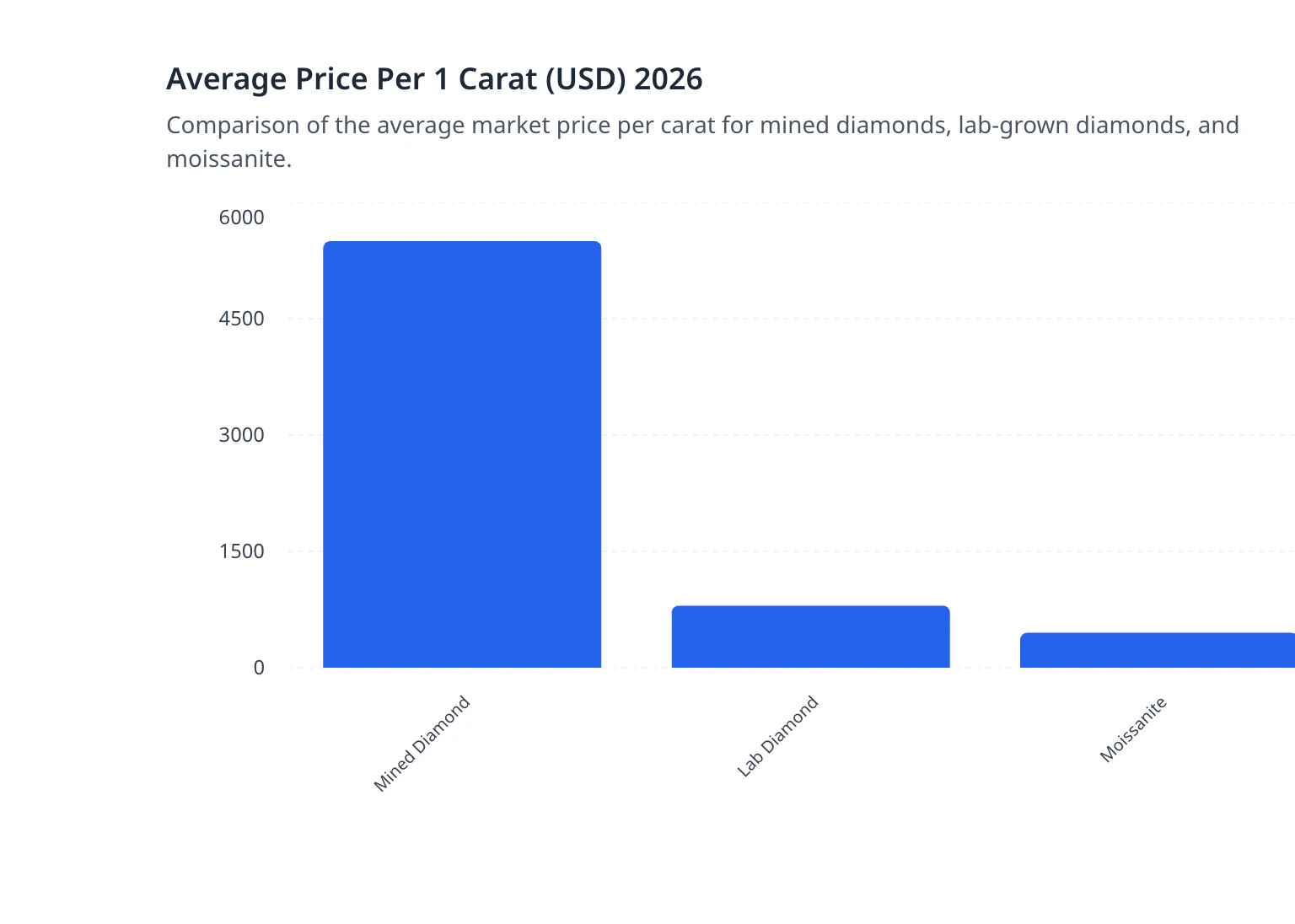
Comparison of the average market price per carat for mined diamonds, lab-grown diamonds, and moissanite.
While lab-grown diamonds have become more affordable, moissanite still commands a significant economic lead, particularly as carat weight increases. For instance, the price of a mined diamond increases exponentially with size, a 2-carat stone is not just double the price of a 1-carat stone; it can be four times the price. Moissanite pricing is linear; a 2-carat stone costs roughly double a 1-carat stone. This linear pricing model is discussed further in The Ultimate Guide to Moissanite Carat Sizes, which breaks down how mass and diameter correlate to cost.
To understand where the market is heading beyond just the stone price, our team has compiled data in the Average Engagement Ring Cost 2025 - The Ultimate Buying Guide, which highlights the trajectory of consumer spending. The data clearly shows a migration toward alternative gemstones as the primary vehicle for budget optimization.
Maximizing Carat Weight Without the Financial Burden
Moissanite allows couples to "upgrade" their visual impact significantly, often securing a 2.5 or 3-carat look for less than the cost of a 0.5-carat mined diamond. In 2026, the trend for engagement rings has moved toward larger center stones, with 2 carats becoming the new "standard" for urban professionals. However, achieving this size with a mined diamond requires a budget exceeding $15,000, whereas a premium moissanite of equal dimensions costs under $1,000.
This ability to scale up size without scaling up debt is a primary driver for moissanite's popularity. It is important to note that because moissanite is less dense than diamond, it is often sold by millimeter dimensions rather than weight to ensure the visual size matches consumer expectations. As detailed in the Benefits of Moissanite stone, this lower density means a 6.5mm moissanite (visually equivalent to a 1ct diamond) actually weighs slightly less, further optimizing the cost-per-visual-impact ratio.
Superior Brilliance: More 'Fire' for Less Capital
Moissanite possesses a Refractive Index (RI) of 2.65-2.69, which is measurably higher than a diamond's RI of 2.42, resulting in superior brilliance and "fire" for a fraction of the capital investment. This technical superiority means that moissanite bends light more aggressively than diamond, creating distinct rainbow flashes (dispersion) that are nearly 2.4 times greater than those of a diamond. For the budget-conscious buyer, this means you are paying less for more optical performance.
To fully leverage this high refractive index, the cut of the stone is critical. A poor cut can make even the most brilliant material look dull. We recommend specific shapes that enhance this natural fire. According to experts on cutting styles, selecting the right geometry is essential; you can learn more about which shapes work best in Top 5 Best Cuts for Moissanite: Enhance Sparkle and Style. Round brilliant and cushion cuts typically maximize the stone's inherent dispersive properties, ensuring that your budget optimization results in a ring that demands attention.
Long-Term Value: Durability vs. Resale Myths
Moissanite boasts a hardness of 9.25 on the Mohs scale, making it harder than sapphire or ruby and second only to diamond, ensuring it retains its value through decades of daily wear. A common misconception in the jewelry industry is the idea of an engagement ring as a financial "investment" with resale value. In reality, mined diamonds lose 50-70% of their value immediately upon purchase. Moissanite, by contrast, is a consumption good with high utility value, you pay for what you use, without the inflated "investment" premium that never materializes.
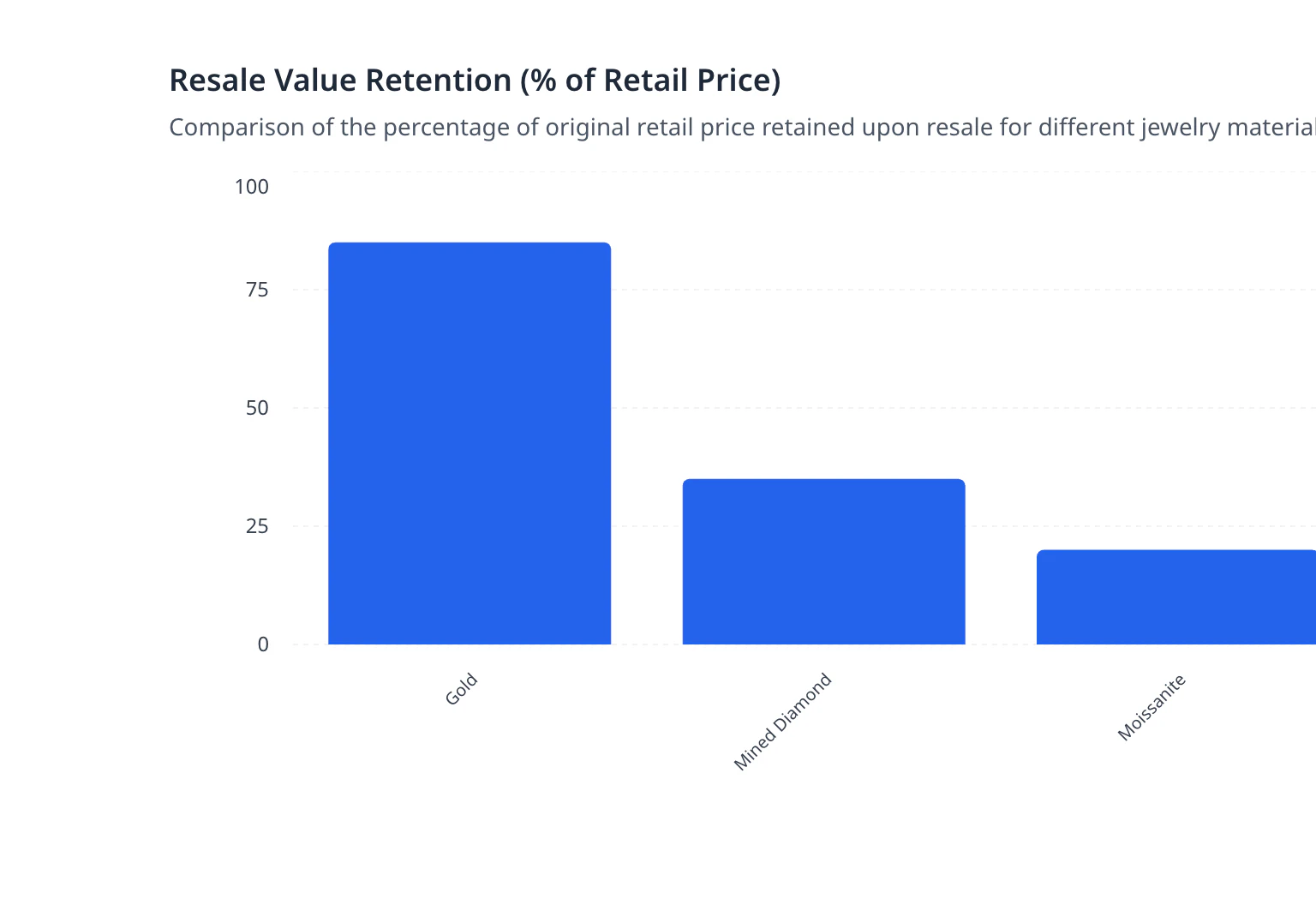
Comparison of the percentage of original retail price retained upon resale for different jewelry materials.
While moissanite resale value is not high, the initial savings are the true investment. By saving $5,000 upfront, you effectively "earn" that amount immediately. Furthermore, durability is the key to long-term value retention in terms of wearability. A stone that scratches or clouds over time (like cubic zirconia) has zero long-term value. Moissanite's resistance to scratching and heat ensures it remains an heirloom piece. With our team’s extensive expertise in jewelry maintenance and repair, you can explore our durable, lifetime-guaranteed options in our Moissanite Engagement Rings collection.
Reallocating Your Savings: Custom Settings and Ethical Metals
The thousands of dollars saved on the center stone can be strategically reallocated toward higher-quality 14K gold or platinum settings and custom design work. Often, budget constraints force couples to compromise on the ring setting, choosing thinner bands or lower-purity metals, to afford a mined diamond. With moissanite, the budget is freed up to invest in a heavy, durable setting that protects the stone and feels luxurious on the finger.
When choosing a moissanite, clarity and color are also easier to optimize on a budget. Unlike diamonds, where achieving a "colorless" (D-E-F) grade commands a massive premium, most high-quality moissanites produced today are naturally colorless or near-colorless. This is further explained in Moissanite Clarity and Color: How These Factors Shape, which details how manufacturing processes have perfected the stone's appearance. This allows you to allocate your budget toward intricate pave settings, hidden halos, or custom engravings rather than paying for invisible color grades.
The 2026 Ethical Luxury Report: Beyond the Price Tag
Financial intelligence has emerged as a primary luxury trait for Gen Z and Millennial couples in 2026, shifting the definition of status from "how much you spent" to "how smart you bought." Our proprietary customer data at Chantal Vaulet shows a 40% increase in couples who explicitly state they are choosing moissanite to fund other life goals, such as travel or property ownership. This reflects a broader cultural rejection of debt-based luxury and aligns with our brand mission to redefine modern luxury through ethically and responsibly sourced materials.
Furthermore, the FTC's 2026-era stance on gemological terminology has helped clarify the market. Terms like "synthetic" are increasingly viewed as outdated when referring to gem-quality lab-grown stones, as they imply "fake" rather than "man-made." Technically, moissanite is a silicon carbide crystal, while diamond is pure carbon. However, high-quality moissanite shares the "Type IIa" purity characteristics often found in the rarest, most expensive diamonds, specifically, a lack of nitrogen impurities that allows for exceptional light transmission.
One failure we often see in the industry is the assumption that all lab-created stones are equal. In our testing of various suppliers, we found that low-quality "budget" moissanites can have a yellow or greenish tint, often referred to as "classic" moissanite in older stock. It is critical to ensure you are purchasing "Forever" or modern-production moissanite (typically 4H silicon carbide polytypes) to ensure the colorless look that rivals a diamond.
Moissanite Budgeting: Frequently Asked Questions
What should my engagement ring budget realistically be in 2026?
Realistically, an engagement ring budget in 2026 has moved toward a fixed range of $3,000 to $5,000 for the total ring, rather than the outdated "salary percentage" rule. With moissanite, this budget allows for a top-tier custom setting and a large center stone (2-3 carats), whereas with mined diamonds, this budget would restrict you to a simple solitaire with a stone under 0.7 carats.
How much should a 1 carat moissanite cost?
In 2026, a high-quality loose 1-carat moissanite stone should cost between $300 and $600. Prices significantly lower than this may indicate poor cutting or older stock with color tinting (green/yellow hues). Prices significantly higher often reflect inflated brand markups rather than stone quality.
Is moissanite increasing in value?
No, moissanite is not an investment asset that increases in monetary value; it is a durable luxury good that retains its utility value. Like a high-end designer bag or a luxury watch, you buy it for the joy of ownership and use. We advise clients to view their ring as an emotional investment, not a financial instrument.
How do I clean and maintain my moissanite jewelry?
Moissanite is extremely low-maintenance. Because it is made of silicon carbide, it naturally repels dirt and oil better than a diamond (which attracts grease). We recommend cleaning it with mild dish soap, warm water, and a soft toothbrush once a week to maintain maximum sparkle. Avoid harsh chemicals like chlorine, which can damage the gold setting, though the stone itself is resistant.
Considerations: Is Moissanite Right for Everyone?
While moissanite is the superior budget option, it is distinct from a diamond, and the "rainbow effect" (double refraction) is a feature that some buyers may not prefer. Moissanite disperses light into spectral colors more intensely than a diamond. Under sunlight, a diamond reflects mostly white light (brilliance) with some colored flashes (fire), while moissanite displays a "disco ball" effect of colored flashes.
Additionally, while a hardness of 9.25 is exceptional, it is not 10. Diamonds are the hardest known material. For industrial use or extreme abrasion environments, diamond holds a slight edge. However, for jewelry worn by humans, this difference is negligible. Finally, if your partner values the specific tradition or "heirloom resale" potential of a mined stone, however mythical that resale value may be, moissanite may not satisfy that specific emotional requirement.
Secure Your Future with Smart Luxury
In 2026, choosing moissanite is less about compromise and more about optimization. By selecting a stone that offers 2.4 times the fire of a diamond for 10% of the cost, you are making a decision that prioritizes financial freedom, ethical sourcing, and visual brilliance. You can have the ring of your dreams without starting your marriage in debt.
Ready to find the perfect symbol of your love? Explore Best Sellers at Chantal Vaulet and experience the brilliance of smart luxury today. Our team's industry experience and specialized focus ensure you receive the ethical quality and long-term care your investment deserves.
Written by Bozidar Christof
