

Amora
Heart Pavé
Explore the made-to-order Amora heart engagement ring and compare shape definition, stone documentation, pavé detail, gold and ring sizing.
Shop by shape
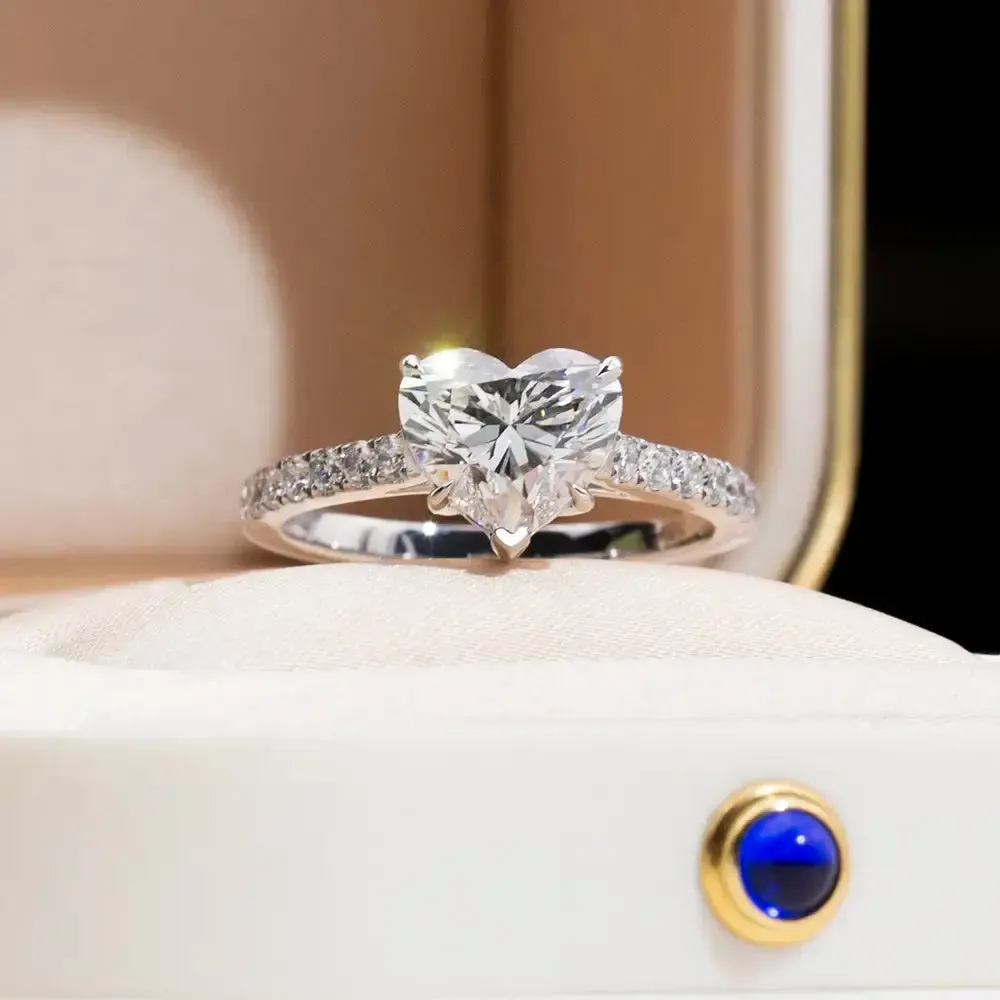
Begin with the outline in the product photographs. Amora should show two balanced lobes, a visible cleft and a centred point. The pavé accents add light along the ring and make the design more decorative than a plain solitaire. Check the side profile, prong placement and band width as well as the face-up view, especially when the ring will be worn daily.
The product selector is the authority for available stone, carat, gold and ring-size combinations. A lab-grown diamond option includes its corresponding IGI grading report; a moissanite option includes the certificate supplied for the individual stone. Because heart cuts are judged heavily by symmetry, review the individual documentation and actual media instead of relying on carat alone. Measure before ordering using the ring-size guide, and use the quote request if a compatible Amora detail needs review.
Questions
Look for two even lobes, a defined central cleft, a centred point and a length-to-width ratio that keeps the heart recognizable in the chosen setting.
No. Amora combines a heart centre stone with pavé detail, giving it more sparkle and ornament than a plain-band solitaire.
A suitable prong or protective setting detail should secure the lower point. Avoid impacts and request inspection if the prong catches, moves or feels loose.